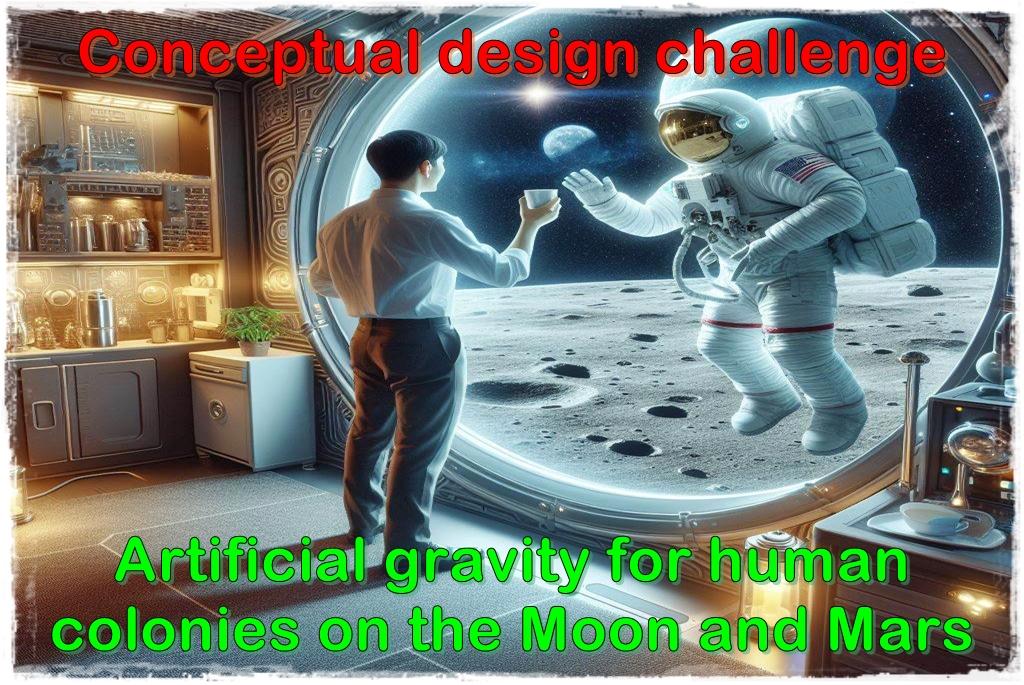
Although it is not a weekly challenge, as is the spirit of this group, I think it is valid to publish it in this place where many design challenge enthusiasts gather.
In this case, it is about working on the "conceptual stage" of the design, in which it is about generating the greatest number of ideas (in principle, with a low but sufficient degree of definition) and then choosing the most suitable ones for its implementation detailed development.
In the final "links" section of the challenge tutorial you will find previous tutorials in which some of these ideas are developed.
We are waiting for you!
Dear challenge participants:
Tomorrow, Wednesday, July 31, 2024, 11:55 p.m. (UTC-3) is the deadline for submitting proposals.
Those who wish to be evaluated (and obtain certificates of participation, if they are GrabCAD guest users) must send me an internal message indicating that they have completed their proposal, so that I can add the "Final version" tag to it. Otherwise, the proposals will remain provisional and will not be evaluated.
In the challenge tutorial we will publish the template to be used for the evaluation of the proposals (either from UNR students or from GC guests who generate and report final versions).
With this we try to make our evaluation criteria totally transparent, clarifying that our perception/opinion/evaluation may differ from that of each participant and, therefore, we also suggest that you "do a self-evaluation" using the same criteria in order to eventually compare the perception that each designer has of his or her work with that of other colleagues who are circumstantially in the position of evaluators.
Kind regards!
PS: in this challenge there are no winners or prizewinners, nor do we intend to compare scores between participants. The objective of the scores is to "help evaluate weaknesses and strengths" clarifying that they correspond "to our vision, arbitrary and eventually biased, but definitely well-intentioned."
Why don't we study what would happen to the astronaut and his cup of coffee when they travel to different points in the habitat?
Conceptual engineering makes sense if the first thing you do is "generate ideas to accomplish a certain desired useful effect."
To do this, you don't need to model or render or waste time on details. In this case, having provided a 3D habitat, all you needed was to "emulate in MOTION the movement that is proposed as an idea" (before spending time drawing the mechanisms to achieve such movement) and "analyze it thoroughly" to criticize its quality!!! As you can see, just drawing a sketch to obtain several points "inside the habitat" and defining a turning axis were enough to "start seeing in detail the quality of our EUD" and realize things such as: the relative size between the habitat and the turning radius!!! and discover or at least reflect on "what will happen to the astronaut and the cup of coffee in his hand" when he walks through the habitat going through those points (and suffering the variations in artificial gravity)... among many other things REALLY IMPORTANT FOR CONCEPTUAL ENGINEERING!
Could it be that they have focused on "the shell" instead of focusing on "the concept and its ability to comply with the EUD"???
PS: in step 11 (reflections) I give an example of what would be expected for the first steps (the first few minutes after proposing an idea!) of the conceptual study.
Please do not open any links and do not make calls (including WhatsApp) to any numbers from messages sent by accounts such as Grabcad Verification, etc. - these are phishing ones. Please do not make any payments. Our security team is currently working on a solution.