Recently I have read several discussions where many good GrabCAD users express their concern about various problems, such as spam control, quality of work, and prestige/usefulness of the community. They even fight among themselves (who are on the good team) because of others who do things wrong, from the shadows and knowing that their actions will not be easily canceled or punished.
My modest proposal is to "act positively": if it is difficult to combat what is bad, let's add things that are good in the hope of balancing or, at least, contrasting so that the bad does not end up overshadowing the good.
In this sense, since last year I have been adding my mechanical engineering students from UNR to the GC community, whom I demand to work hard with the quality of what they publish. To this end, I make them participate (whenever possible) actively in NASA challenges such as https://grabcad.com/challenges/nasa-challenge-positive-connections-a-mechanism-to-connect-on-contact which was won by one of them https://grabcad.com/library/egyptian-key-1.
In the absence of an active challenge, we are now doing "solution post-processing" work based on https://grabcad.com/challenges/nasa-challenge-lunar-gateway-cargo-packing-and-storing. The deadline is April 24, but there are already some proposals available that I am publishing at: https://grabcad.com/tutorials/creativity-in-engineering-part-4-cpdc-results.
I am not saying that this is a solution or a highly significant action but symbolically I consider it important. If you share this vision, I ask you to support my students as some notable GC users have already done through their likes and comments. For any of them, receiving a comment or a like from someone they don't know but whom they can admire through their work in GC, implies enormous motivation. Maybe for you it is a small gesture of approval, but believe me: it is very significant.
Thank you so much!
Marcelo
Thank you very much Stéphane, especially for your spontaneous support of the students. We value it very much!
No problem Marcelo, the likes were deserved, a very good job given by your students, you are lucky to have such gifted students who also surely have your pedagogy....
Thank you very much Stéphane, again!
The talent of the students is rarely expressed in this university that tries to make you a professional following an old, rigid and very unmotivating analytical recipe.
I believe that the greatest teaching contribution is "lighting the flame and inducing self-learning." Because the mere transmission of a set of knowledge, although valuable, is limited in quantity (due to lack of time) and biased in quality (due to the technical capacity of the teacher).
We older people know that in any profession the fundamental thing is permanent practice and introspection that leads to self-learning. We even use this same thing to improve, put in crisis and relearn the specific knowledge that was transmitted to us imperfectly (imperfect teachers and methods + immature learners) in school, university and industry.
Again, thank you very much for your feedback!
PS: the first 25 entered GC for the challenge https://grabcad.com/challenges/nasa-challenge-positive-connections-a-mechanism-to-connect-on-contact:
01. https://grabcad.com/matias.gasparotti-2
02. https://grabcad.com/bruno.giudici-2
03. https://grabcad.com/manuel.larreteguy-2
04. https://grabcad.com/agustin.amerise-2
05. https://grabcad.com/fernando.vilanova-1
06. https://grabcad.com/juan.pividori-1
07. https://grabcad.com/brandon.montilla-1
08. https://grabcad.com/kevin.brain-3
09. https://grabcad.com/lisandro.luna-2
10. https://grabcad.com/pedro.alexis.beltramo-1
11. https://grabcad.com/giuliano.scarafile-1
12. https://grabcad.com/rocio.neuhaus-1
13. https://grabcad.com/alfredo.soto-5
14. https://grabcad.com/agustin.trosarello-1
15. https://grabcad.com/esteban.pascual-4
16. https://grabcad.com/damian.corgniali-1
17. https://grabcad.com/facundo.cabrera-5
18. https://grabcad.com/luciano.bruno-3
19. https://grabcad.com/bianca.delprato-1
20. https://grabcad.com/marco.nannini-2
21. https://grabcad.com/franco.pizarro-1
22. https://grabcad.com/benjamin.cinto-2 (1st prize of the challenge)
23. https://grabcad.com/franco.ozerio-1
24. https://grabcad.com/enzo.rosendo-1
25. https://grabcad.com/matias.gasparotti-2
PS: another group of new users will enter this semester, and also another during the second semester. You will be able to corroborate that none of them (with rare exceptions) follow me or like my models, because I always tell them: they already know my name and where to find my work, therefore, they do not need to follow me on GC (although I do value the comments that induce some learning from my models or tutorials, which are always directed at them).
It is true even in France, I see that it seems to be a little similar also in Argentina certainly not only, that transmission with a lot of pedagogy and passion is rare, yet the educational structures are there to support all. But in the end everything will relate to the human who must officiate and it's true that I was more often at the back of the class waiting for the bell than in front of me with wide eyes and open ears... At the same time I don't throw away don't blame teachers, it's not an easy job when students aren't motivated, it must be quite discouraging... I think your students are in good hands and they're very lucky!
I'm glad to have seen this encouraging topic of discussion, and it sparked an idea to me.
Despite the absence of a moderator, managing or eliminating spam might seem challenging, but fostering a collective positive mindset among all contributors may make the community more self-sustaining.
Just my thoughts on the matter.
Hi Derrick!
I agree with you. A positive action is something that is entirely in our hands (under our control) and nothing prevents us from doing it.
It's simply about "reinforcing the good side" instead of "fighting the bad side" (which is something that should continue to be done, to the extent possible, but which is not in the hands of GC users for now).
Greetings!
Thank you very much @Vic Chen!
I trust that this will be a way to protect and improve the GrabCAD community because "radical and immediate" solutions simply do not exist (or at least, they are not within our reach).
In this link the list of design proposals from my students (and new GrabCAD users) was updated:
https://grabcad.com/tutorials/creativity-in-engineering-part-4-cpdc-results
Some reflections and lessons learned and to be learned have also been added!
In the short term we hope to have the reflections of the students and teachers themselves, as well as the comments of other GrabCAD users (and hopefully also the judges of the challenge used as the basis for this design practice!).
I am infinitely grateful for the support you have given my students with your likes and valuable comments.
Kind regards!
Marcelo
PS: the contribution was very modest, but very real. We have 23 new "handmade and good quality" models plus an equal number of "valuable new users" for GrabCAD!
A new challenge, open to the entire GrabCAD community, continues previous work:
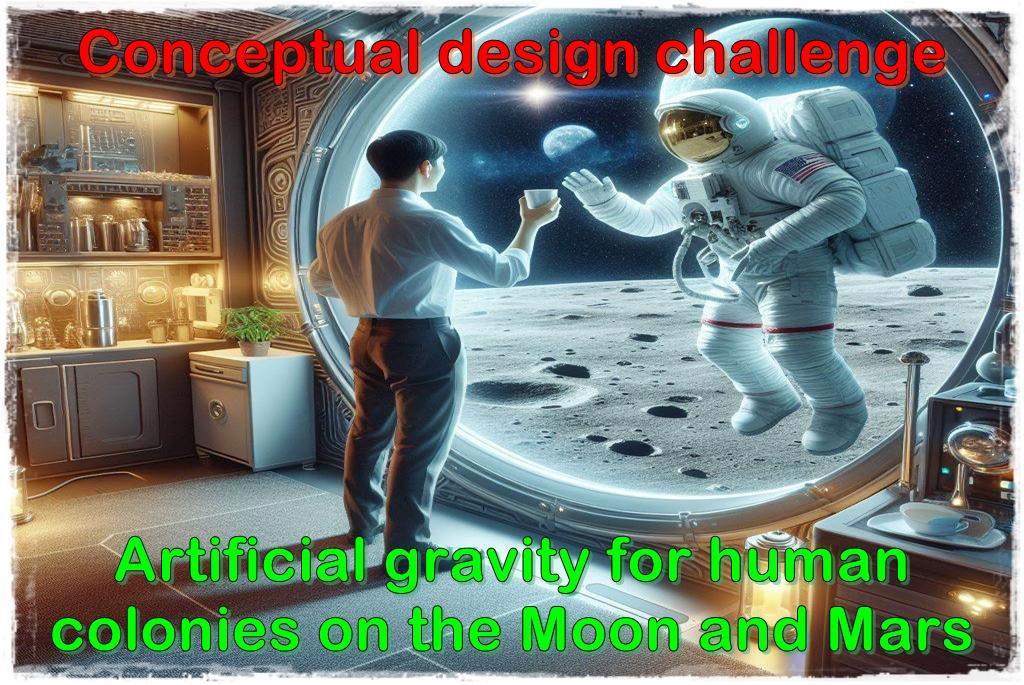
We hope that GrabCAD users, enthusiasts of design challenges, will join us with their proposals and together we will learn something more about good conceptual design practices.
Hello everyone!
Since there is no way to "follow a tutorial" to stay up to date with its updates, I want to invite you to watch the "artificial gravity" challenge tutorial. It doesn't matter if you present proposals for it or not, I think it may be useful to review some ideas about how creativity works (which constitute the main objective of the challenge). Some cite tools such as low definition sketches (related to optimal use of our limited "working memory") and have justified the creation of new tutorials such as:
Working principles in conceptual engineering | GrabCAD Tutorials
Other ideas have been included in section 11: Reflections and lessons learned, such as those related to "the layers of the onion" in conceptual work and the ease of emotional blocking of creativity.
I hope it is useful and encourages you to consult, give your opinion, question and, ultimately, learn as a group about our greatest ally as designers: creative capacity!
Possible routine tasks for people on a typical day on the moon... as a reference for our conceptual designs!
See comments in the tutorial chat.
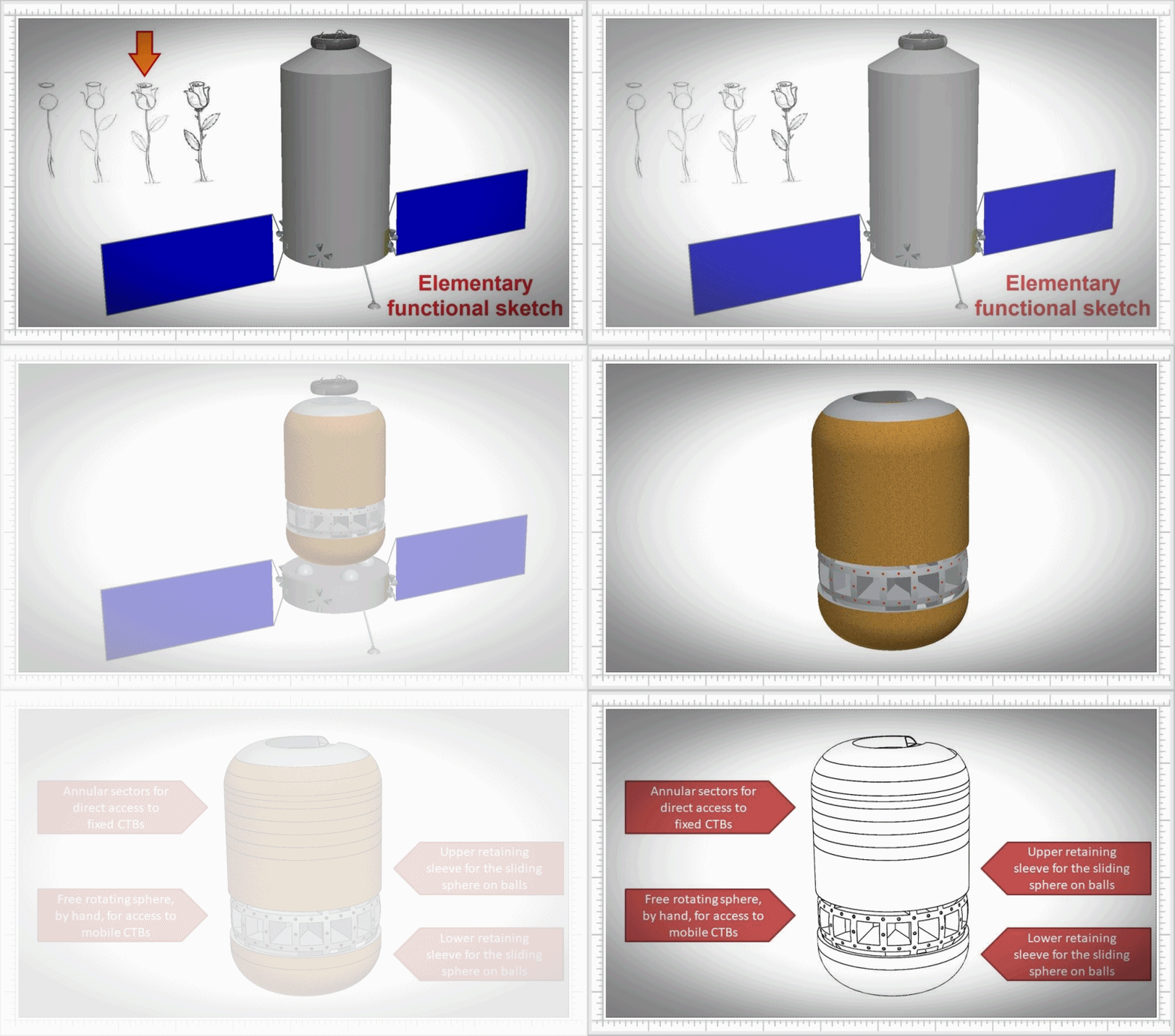
I remind you of the usefulness of low-definition functional sketches as agile tools to generate and evaluate ideas with an increasing degree of definition.
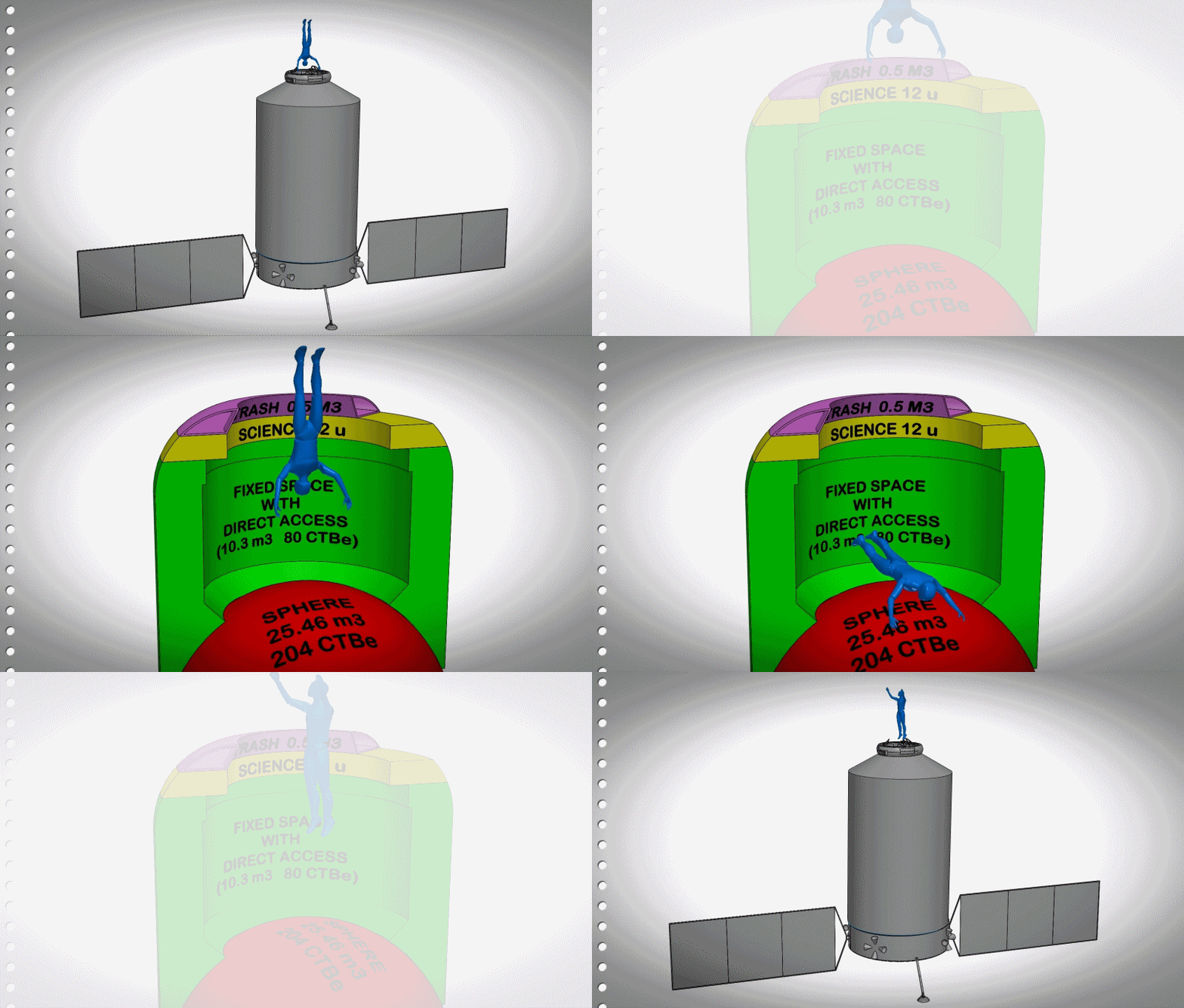
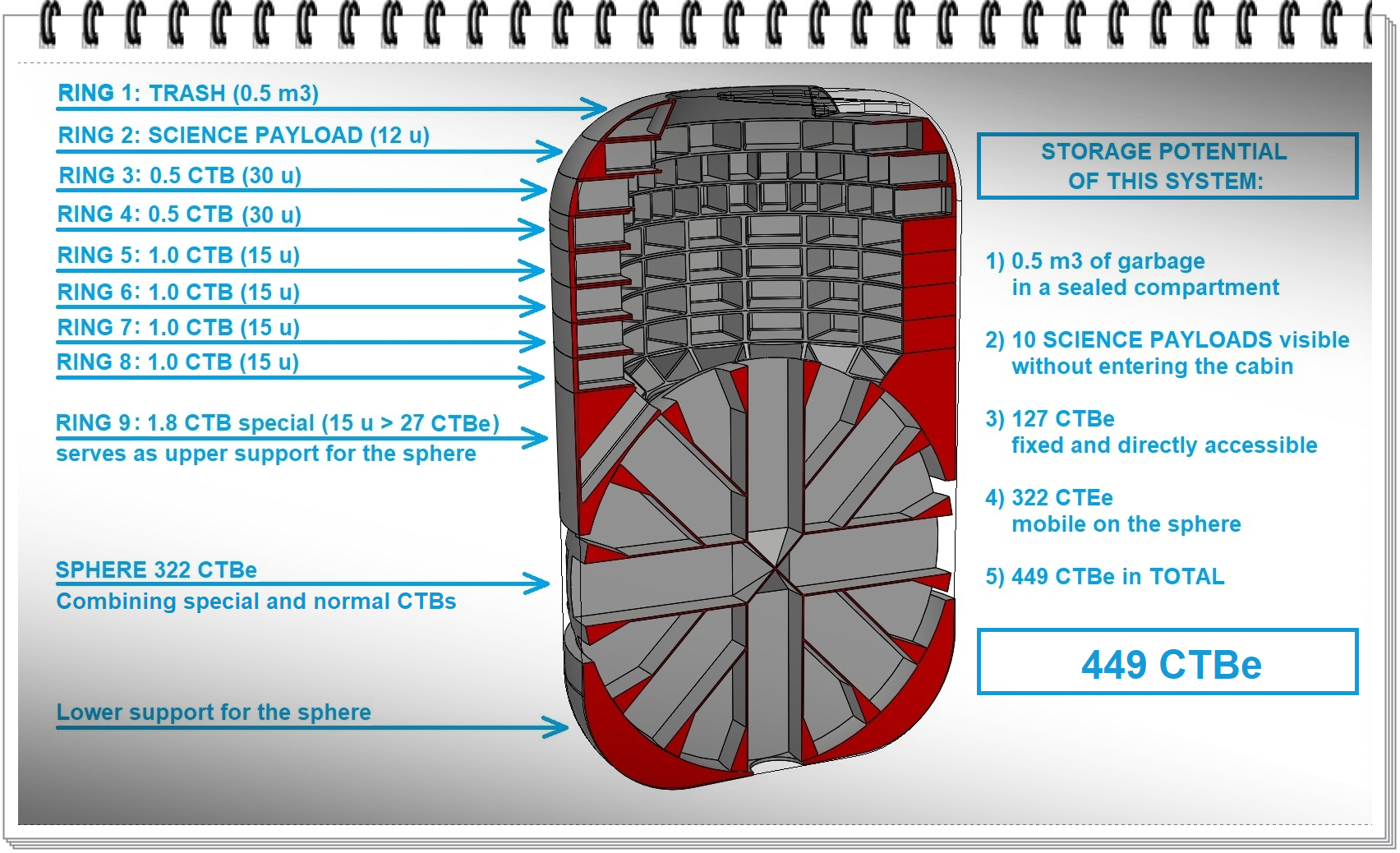
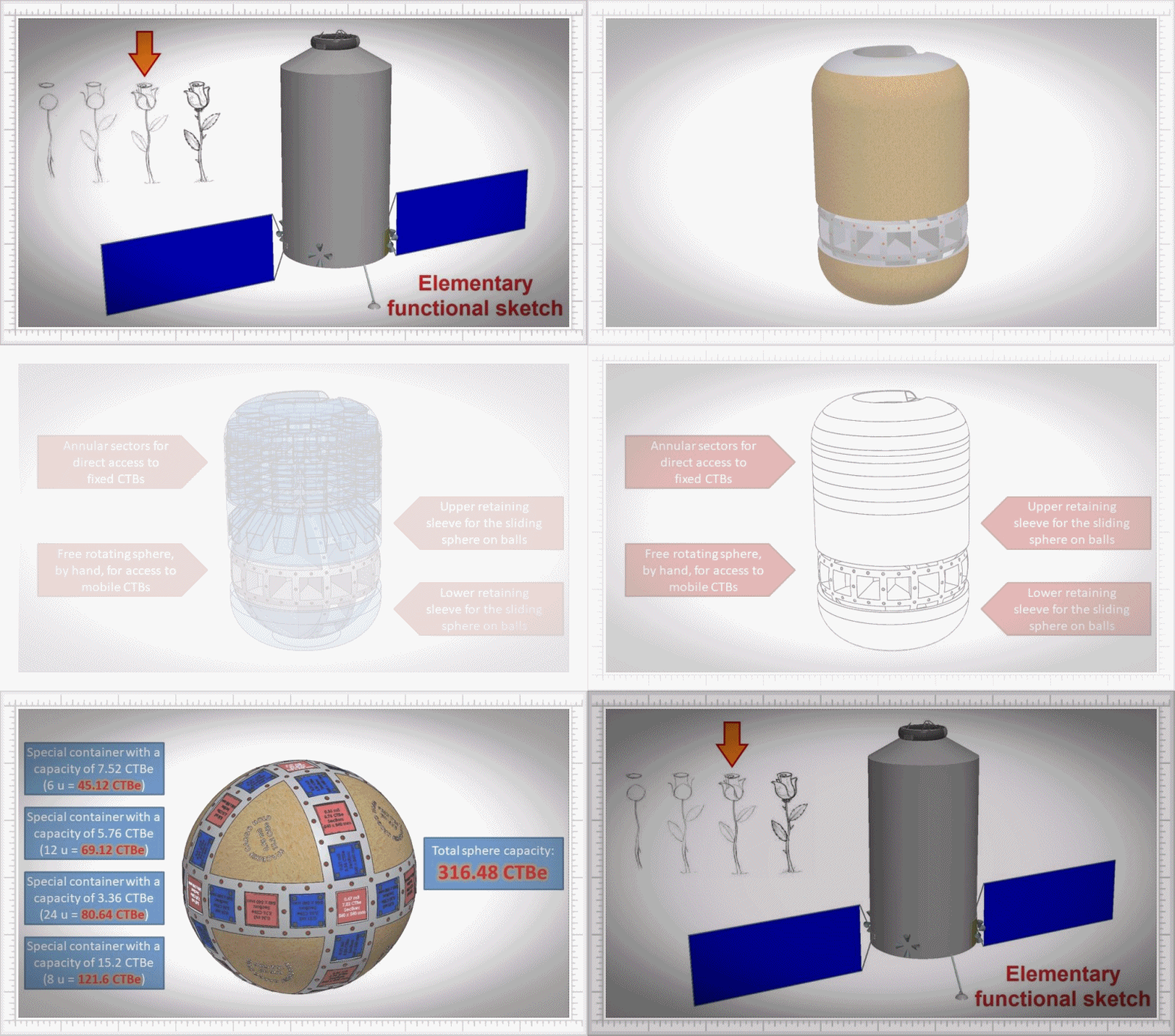
We have the model https://grabcad.com/library/the-sphere-ii-1 that shows a very low level of definition (although not the lowest possible) and allows us to approximately quantify the Desired Useful Effect for the system.
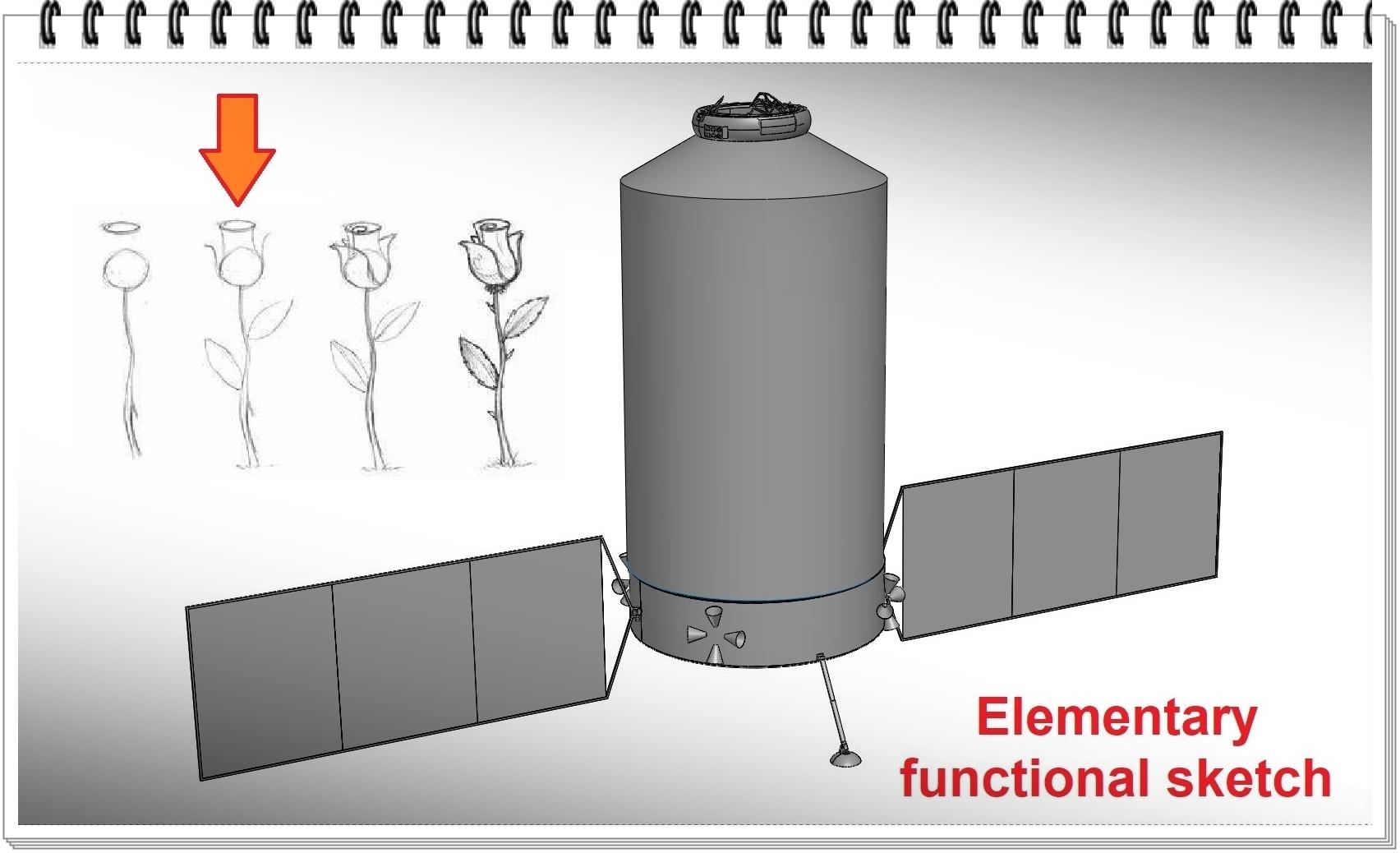
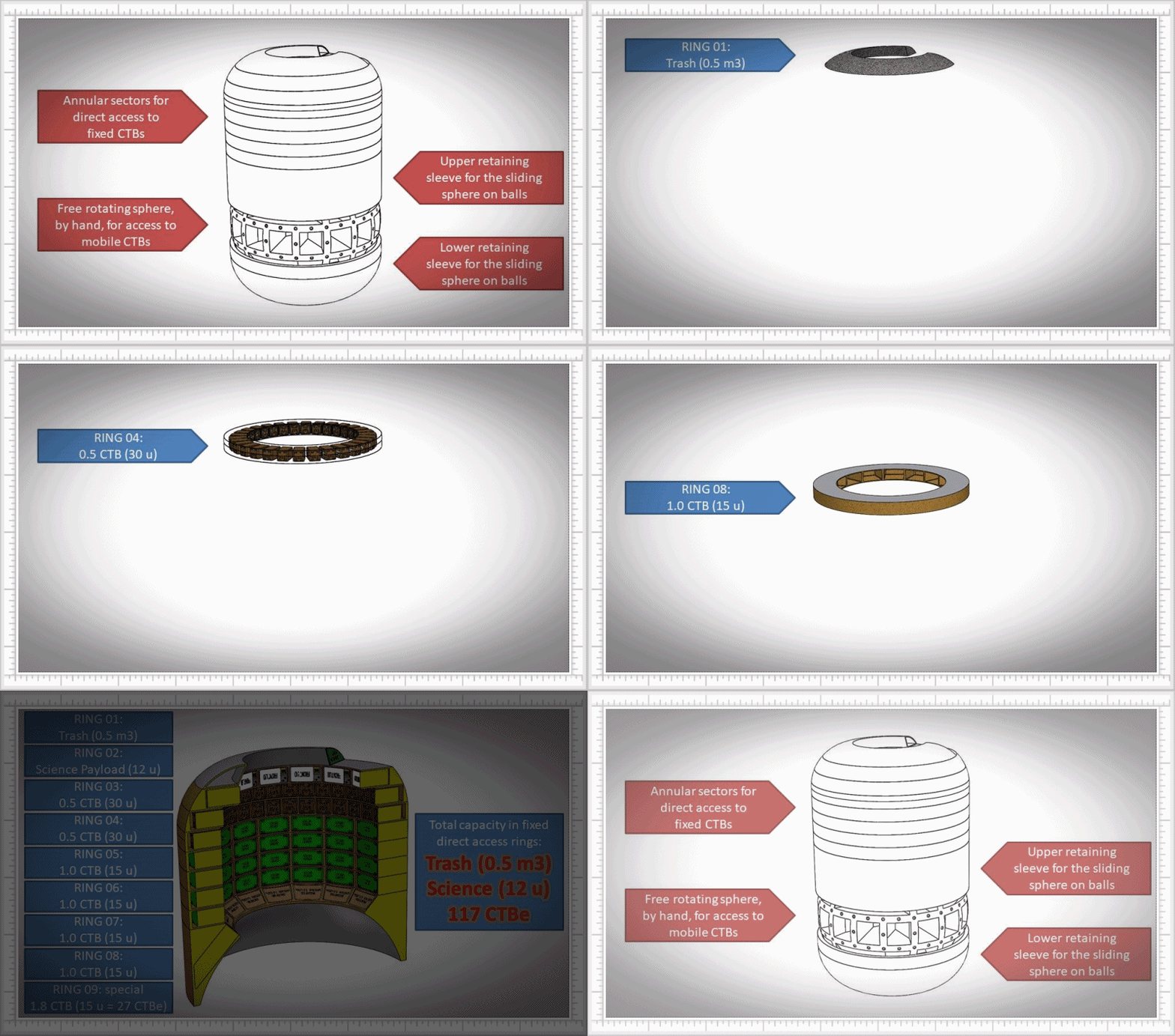
Now I have added the model https://grabcad.com/library/the-spherre-iii-1 which has a higher level of definition (although it is not the maximum possible for conceptual engineering purposes) that allows ideas to be refined and the Desired Useful Effect.
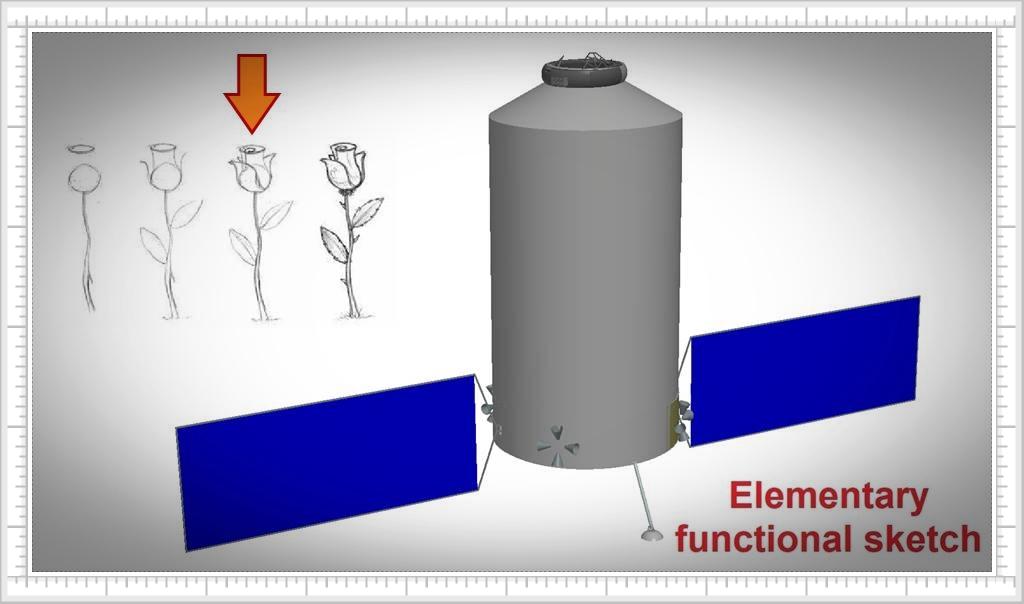
I hope everyone can apply these concepts to the ongoing challenge.
Kind regards!
Marcelo
PS: I may soon be able to add the "Sphere I" model to further illustrate the range of definitions of the aforementioned sketches.
The sequence of low definition functional 3D sketches has been completed:
I hope you can observe them and glimpse at which stages (aspects and objectives) of conceptual engineering each of them are most useful.
Kind regards!
Marcelo
Why these spheres!?
The contest isn't it about Moon train?
I have some doubts about the idea of this train to recreate the force of Earth's gravity on the Moon.
If from a physical point of view your calculation of the centrifugal force to increase the lunar gravity and recreate the terrestrial one is correct, the problem is of a psychological nature.
Have you asked yourself the problem that you won't be able to look outside because you would see everything running continuously 24/7?
In other words the problem is that he can dizzy.
What do you propose to solve this problem!?
Ti saluto!
Germano Pecoraro -Designer - Italy
Hello Germano,
Let's go in parts:
1) The "sphere" examples come from a previous challenge and I made them to illustrate the "types of sketches" that are useful when doing conceptual engineering. I have also given some examples in this regard for the specific case of "artificial gravity" but I did not want to go into them in depth to avoid presenting solutions that, in reality, I want the participants to come up with.
2) This challenge "is not about a train" but about "any way to recreate gravity artificially." The train is the first way I came up with to apply the "working principle" related to "centripetal acceleration". It should be noted that this operating principle "is not the only possible one" but there are others such as magnetic fields that the participants are evaluating.
3) Specifically the case of the train and "what a person would see from inside it" is an interesting question, but it is still minor compared to the long-term health problems that microgravity causes. There are some situations to consider:
3.1) One of my trains (the one on the Moon) I chose to circulate with a linear speed of 133 km/hr (relatively small for the trains we are used to on Earth) along a circumference of 282 meters in diameter. That is to say, it makes 2.5 turns in one minute in said circumference. Due to the natural component of lunar gravity, the cabin must rotate around its axis about 9 degrees with respect to the horizontal. This implies that "natural visibility" would be practically towards the sky and not towards the surface, but...
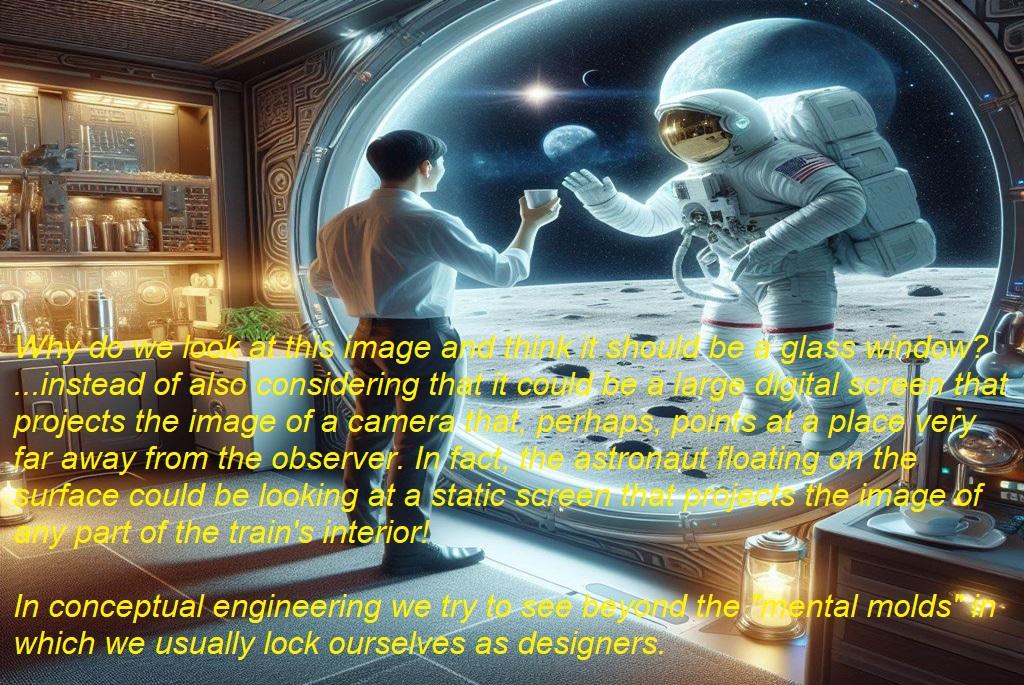
3.2) Who said that habitats have to have windows and that from inside we will observe through glass???? For structural reasons of the tank with which the habitats are built, it is most likely that they try to minimize "openings" (whether windows or hatches). This leads me to think about "using digital screens" as a replacement for real windows. These digital screens would "project the images taken by cameras" that can maintain (if desired) an almost fixed point of view, even on the lunar surface, moving synchronously with the progress of the train!!!
It doesn't matter if my solutions are good or bad. This exercise is about "learning to think as diversely as possible" and we are not looking to refine a true solution (which we will achieve anyway). It's a design exercise and "the specific problem of artificial gravity" is just an excuse!
Kind regards,
Marcelo
PS: of course the images that astronauts see in their "virtual windows" (digital screens) can also come from static cameras located on the surface and pointing towards the place they want to observe.
An interesting question in the comments of the tutorial leads me to express that: it is convenient to separate (in time) the conceptual definitions (which point to the Desired Useful Effect, e.g.: artificial gravity) from the instrumental definitions (which point to many other important but "separable" aspects such as durability, reliability, resistance, etc. etc.).
For this reason "design engineering" is separated into stages: conceptual, basic and detailed!!!
Hello everyone!
For those who want to know why I insist so much on the topic of "low definition functional sketches" I have created the tutorial:
Our working memory and its storage in sketches
I think it will be useful for you to know something about the optimal use of our brain resources for design tasks.
I hope you enjoy.
Greetings,
Marcelo
DO NOT DELETE OR CHANGE THE NAME OF THE MODELS ALREADY INCORPORATED TO THE LIST
Hello everyone!
Given that the system for accessing authors and models that we are using is very rudimentary (a simple list with links), it is essential not to eliminate or change (the name, for example) the models that have already been incorporated into the list because, otherwise In any case, we lose access to them and it is distorted.
Greetings!
Marcelo
Hello everyone!
I want to share with you a "lessons learned" from a simple weekly challenge, which I proposed as an excuse to talk about some "conceptual design" topics (clarifying that this is the first stage of design, prior to the "basic design" and later "detailed design" as this issue has generated some misunderstandings).
The simple weekly challenge proposed:
https://grabcad.com/groups/weekly-challenge-group/discussions/a-mechanism-to-move-the-green-orange-rectangle
Reflections on "what we didn't do well" during the conceptual stage:
https://grabcad.com/tutorials/dof-in-engineering-problems-1
Specific proposals to improve our conceptual design practices:
https://grabcad.com/tutorials/dof-in-engineering-problems-2
As always, I hope you find some of this useful or at least spark constructive criticism, discussion, queries, etc. Among all the "CAD-CAE technological" content, it is good, at least from time to time, to be able to have a talk about engineering fundamentals.
Kind regards!
Marcelo
Dear challenge participants:
Tomorrow, Wednesday, July 31, 2024, 11:55 p.m. (UTC-3) is the deadline for submitting proposals.
Those who wish to be evaluated (and obtain certificates of participation, if they are GrabCAD guest users) must send me an internal message indicating that they have completed their proposal, so that I can add the "Final version" tag to it. Otherwise, the proposals will remain provisional and will not be evaluated.
In the challenge tutorial we will publish the template to be used for the evaluation of the proposals (either from UNR students or from GC guests who generate and report final versions).
With this we try to make our evaluation criteria totally transparent, clarifying that our perception/opinion/evaluation may differ from that of each participant and, therefore, we also suggest that you "do a self-evaluation" using the same criteria in order to eventually compare the perception that each designer has of his or her work with that of other colleagues who are circumstantially in the position of evaluators.
Kind regards!
PS: in this challenge there are no winners or prizewinners, nor do we intend to compare scores between participants. The objective of the scores is to "help evaluate weaknesses and strengths" clarifying that they correspond "to our vision, arbitrary and eventually biased, but definitely well-intentioned."
Why don't we study what would happen to the astronaut and his cup of coffee when they travel to different points in the habitat?
Conceptual engineering makes sense if the first thing you do is "generate ideas to accomplish a certain desired useful effect."
To do this, you don't need to model or render or waste time on details. In this case, having provided a 3D habitat, all you needed was to "emulate in MOTION the movement that is proposed as an idea" (before spending time drawing the mechanisms to achieve such movement) and "analyze it thoroughly" to criticize its quality!!! As you can see, just drawing a sketch to obtain several points "inside the habitat" and defining a turning axis were enough to "start seeing in detail the quality of our EUD" and realize things such as: the relative size between the habitat and the turning radius!!! and discover or at least reflect on "what will happen to the astronaut and the cup of coffee in his hand" when he walks through the habitat going through those points (and suffering the variations in artificial gravity)... among many other things REALLY IMPORTANT FOR CONCEPTUAL ENGINEERING!
Could it be that they have focused on "the shell" instead of focusing on "the concept and its ability to comply with the EUD"???
PS: in step 11 (reflections) I give an example of what would be expected for the first steps (the first few minutes after proposing an idea!) of the conceptual study.
Good idea.Although I'm not professional, you make a good suggestion To make This website getting better,You also a good teacher that I can see your efforts to the students.
Do you mind give me some suggestions for Improve the relation from student to teacher?
Hello @yangxueting, thank you very much for your kind words!
I can't speak with authority about the relationship between students and professors, because in my field and country there isn't a formal degree program for "mechanical engineering professors." I'm referring to one that includes courses in didactics, educational psychology, and other subjects specific to teaching professionals.
In my case, I'm simply an "engineer who teaches," and the title of "professor" doesn't really apply to me. Nevertheless, I've been doing this for almost 30 years, in parallel with my professional design work. What I can tell you is that it's important for the person teaching to demonstrate to the students the "relevance" of what they are about to teach. If what you're going to teach doesn't have or doesn't demonstrate relevance to the students, or even if you yourself don't use it daily, it's likely to be difficult to capture their interest and ensure that they retain that knowledge.
Regarding the human aspect of the relationship between professors and students, I've always preferred it to be as close as possible and to "be like a collaborator or a more experienced colleague" who helps them learn (from the ground up, from their own level), instead of someone who is at the pinnacle of knowledge and imparts it from there in a masterful way.
I don't know if my words will be of any use to you, but this is what I can offer you from my experience and without having specific training in teaching methods.
Best regards!
Please do not open any links and do not make calls (including WhatsApp) to any numbers from messages sent by accounts such as Grabcad Verification, etc. - these are phishing ones. Please do not make any payments. Our security team is currently working on a solution.